
Somewhere in your first month on a help desk, a voice on the phone will go from frustrated to loud, and every part of you will want to argue back or transfer them into oblivion. What you do in the following sixty seconds is one of the most valuable skills in tech support, and one of the least taught.
The anger is almost never about you
Start with the reframe that makes everything else possible. The person shouting has usually lost a morning of work, has a deadline breathing on them, and may be on their second or third call about the same problem. You are not the cause. You are just the first human the company has offered them.
That reframe is armor, not an excuse for the rudeness. The tech who hears “this company’s IT is useless” as data about the caller’s morning stays calm and useful. The tech who hears it as a personal verdict burns out by spring. Detachment, the warm kind, is a job skill here as real as any command line.
Let them empty the tank
The strongest de-escalation move is silence. Let the person say the whole thing, uninterrupted, including the unfair parts. Cutting in with “actually, that’s not quite what happened” may be accurate, and it will cost you the call, because a person mid-vent experiences interruption as proof that, once again, nobody is listening.
Then, before any troubleshooting, acknowledge what it cost them. Not the corporate phrase collection, just plain speech: “You’ve lost half a day to this and you have a deadline. Let’s get it fixed.” Two sentences. You will hear the temperature drop on the line, because the thing most angry callers actually want, before the fix, is one person to register that it mattered.
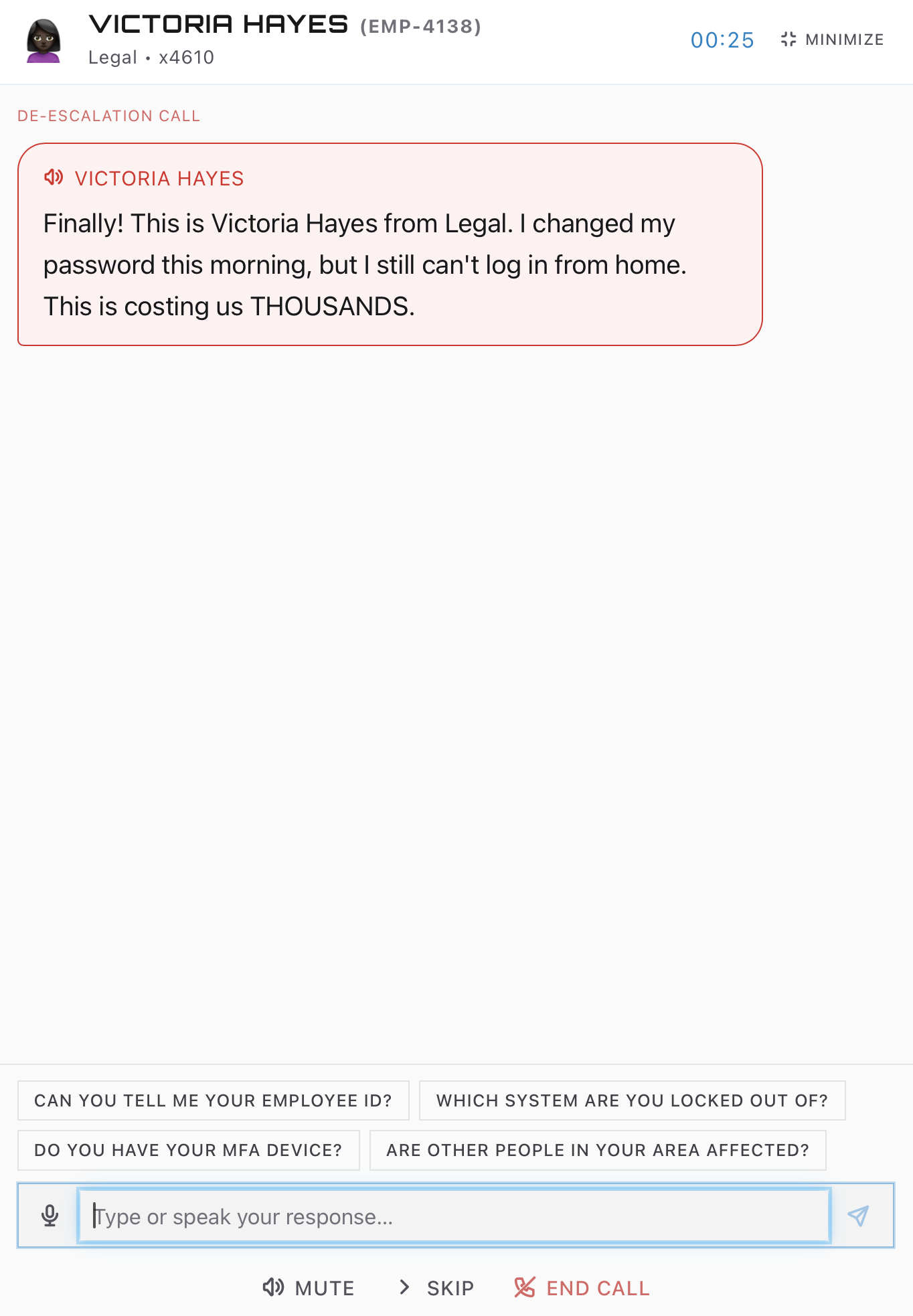
What never works is “calm down,” which in the entire history of the phrase has calmed down no one. Same family: “you should have,” which relitigates the past instead of fixing the present, and “that’s not my job,” which may be true and should still never be said that way. If a ticket belongs elsewhere, the working version is “here’s who fixes this, and I’m handing you to them directly,” which is the same fact wearing help instead of refusal.
Give them motion
Anger feeds on helplessness. The antidote is visible progress: one concrete thing happening right now. “I’m looking at your account as we speak.” “I can see the error from here, and I know what it is.” Even when the fix is long, narrating the first step changes the caller’s status from stranded to in-motion, and in-motion people stop shouting.
Honesty is part of the motion. If the fix takes an hour, say an hour, because a comfortable “just a few minutes” buys you calm now at the price of a much angrier call at minute forty. Under-promising and calling back early is the oldest trick in support, and it works every single time.
And when the anger is aimed at a genuine failure, an outage that keeps recurring, a ticket that bounced between teams for a week, treat the complaint as free consulting. Repeat anger at the same thing is the clearest signal a desk gets about what to fix at the process level. Passing that upward, in your ticket notes and to your lead, is quietly one of the most senior-looking things a junior tech can do.
Where the line is
All of the above applies to frustration at the situation. It stops applying the moment abuse turns personal: slurs, threats, sustained shouting at you rather than about the problem. Absorbing that is not professionalism, and no reasonable desk expects it. The working script is one clear boundary, “I want to get this fixed for you, and I need us to keep this respectful,” and if it continues, a calm handoff to your lead, with the exchange documented in the ticket.
Know where that line is before you need it, because in the moment is a bad time to improvise. Ask your lead in week one how the desk handles abusive calls. The answer also tells you a lot about the desk.
Why this skill compounds
Here is the career secret hiding in the unpleasant calls. Interviewers ask about difficult customers almost every time, precisely because composure is the thing they cannot teach in onboarding. A specific story, the angry caller, what you said, how the call ended, outweighs a paragraph of certifications, and the only way to own such a story is to have taken the call.
The ServiceDesk Simulator puts callers on the line who are having a genuinely bad day, so you can practice the listening, the plain acknowledgment, the honest ETA, and the boundary-setting before a real person is on the other end. The de-escalation reps transfer to real calls better than any script, because what you are actually training is your own pulse.