
The first time you see your own dashboard on a help desk, it is a little confronting. Tickets closed, average handle time, a satisfaction score with your name on it. Support is one of the most measured jobs in an office, partly because it can be, every interaction already lives in a ticketing system that counts things for free, and partly because management genuinely needs to know whether three techs or five techs is the right number this winter. Job postings ask about these metrics, interviews bring them up, and your one-on-ones will feature them. Better to speak the language before it is used on you.
The core numbers
Ticket volume is the weather report: how much work arrived, sliced by day, by category, by channel. On its own it judges nobody, but its shape drives everything else, Monday spikes set staffing, and a sudden surge in one category is how desks notice that yesterday’s update broke something before anyone declares an outage.
First contact resolution, FCR, is the percentage of issues fully handled in the first interaction, no callback, no escalation, no reopened ticket. Desks are a little obsessed with it, reasonably, because it is the rare metric where everyone wins at once: the user is done, the queue is shorter, and tier 2’s time was never spent. A rising FCR usually means the desk is learning, better knowledge base, better-trained tier 1, better tooling.
Average handle time, or its cousin mean time to resolution, measures how long tickets take. This is the most double-edged number on the board. Falling times can mean growing skill, or they can mean rushed work, and the difference shows up two weeks later as reopened tickets. Speed that does not survive contact with the same user calling back was never speed.
SLA compliance is promises kept. The SLA says a priority-2 ticket gets a response in two hours and a fix in a day; compliance is the percentage of tickets where the desk hit those clocks. This is the number contracts and management reviews care about most, which is why a ticket about to breach its clock attracts sudden, focused attention from your lead.
And CSAT, customer satisfaction, is the survey after the ticket closes, how did we do, one to five. It is the only number where the user grades the experience rather than the system grading the process, which makes it precious and noisy at once: the people most likely to answer are the delighted and the furious, and everyone in between archives the email.
Every metric can be gamed, which is the point
Here is the thing veterans understand about metrics: each one, chased alone, produces exactly the wrong behavior. Maximize tickets closed and techs cherry-pick easy ones while the hard ticket ages in the corner. Minimize handle time and quality quietly dies. Chase FCR and tickets that should be escalated get held too long by someone determined to resolve them on first contact. There is a small dark art, practiced on every desk that manages by single numbers, of closing a ticket and letting the user “open a new one” for the same issue, which converts one long honest ticket into two short flattering ones.
None of this means the numbers are useless. It means they work as a set, speed checked against reopen rates, volume checked against satisfaction, and it means a desk’s culture around metrics tells you a lot about whether you want to work there. In an interview, asking “which metrics does the desk track, and how are they used?” makes you sound experienced precisely because everyone experienced has seen the failure modes.
Reading your own numbers
As a tech, your dashboard is most useful as a mirror rather than a scoreboard. Closing fewer tickets than the desk average might mean you are slow, or might mean you keep drawing the gnarly ones, which is a compliment wearing bad statistics. A dip in your CSAT across three tickets is noise; a slide across three months is a pattern worth understanding before your manager asks about it. The habit that separates people who grow from people who plateau is boring: look at your numbers regularly, get curious about the outliers, and treat a reopened ticket as free coaching from your past self.
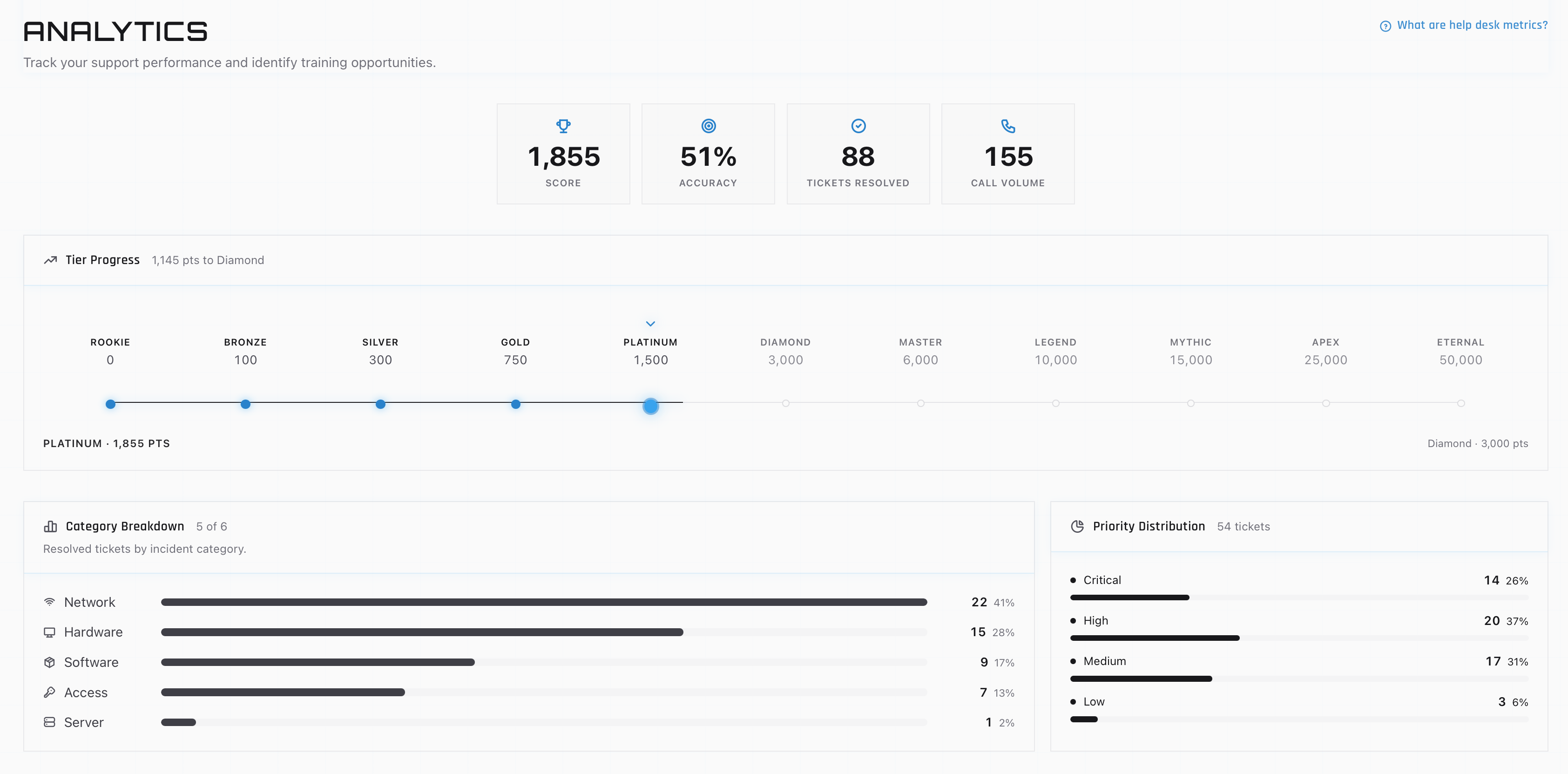
The chicken-and-egg problem, as usual for beginners, is that you cannot read your own support metrics until someone gives you a queue. ServiceDesk Simulator tracks the same numbers a real desk would, tickets resolved, how fast, how well, on an analytics dashboard that fills in as you work through the queue. Watching your own resolution stats climb is good motivation. Walking into an interview already fluent in what FCR is and why handle time lies is better.