CTE IT programs are good at more things than they get credit for. Students leave able to build a PC from a pile of parts, they leave with certifications that open doors, and they leave having had a teacher who cared, which counts for more than any line item. I want that said before the criticism, because the criticism is structural, not a verdict on anyone’s teaching.
Here it is: the entry-level job most of these students will actually get is helpdesk, and almost nothing in most programs resembles helpdesk.
The job is not in the room
Look at what a day in a tier 1 seat contains. Tickets, arriving continuously, written by people who describe symptoms rather than causes. Phone calls where the diagnosis happens through questions because you cannot see the screen. Notes that the next tier will read, escalation decisions about what is yours versus what goes up, and a steady supply of people having a bad day about their technology, some of them loudly.
Now look at the standard CTE lab bench: hardware teardowns, OS installs, cable crimping, exam prep. All legitimate. And notice that not one item from the first paragraph appears in the second. The overlap between the curriculum and the first job is the knowledge; the missing part is the entire activity.
Employers notice the missing part, reliably. Ask anyone who hires tier 1 what certified graduates lack and you get the same list: they cannot drive a call, their ticket notes are chaos, they either escalate everything or nothing. Nobody says the graduates lack knowledge. They lack the doing, because nobody could assign the doing as homework.
Why the gap persists
Not for lack of trying. The programs that run internal student helpdesks are doing the realest version of this work, and the instructors sabotaging lab machines by night are doing the second-realest. But the internal helpdesk depends on unpredictable ticket flow and a tolerant administration, and the sabotage lab costs an evening per run.
The stubborn part is the user. A broken machine can be staged; a believable person attached to the broken machine cannot, not twenty-five times a period. Pair role-play helps and costs nothing, yet an instructor cannot script human friction at scale, and human friction is precisely the skill employers keep flagging. The gap persists because its hardest component was, until recently, not stageable at all.
What closing it looks like
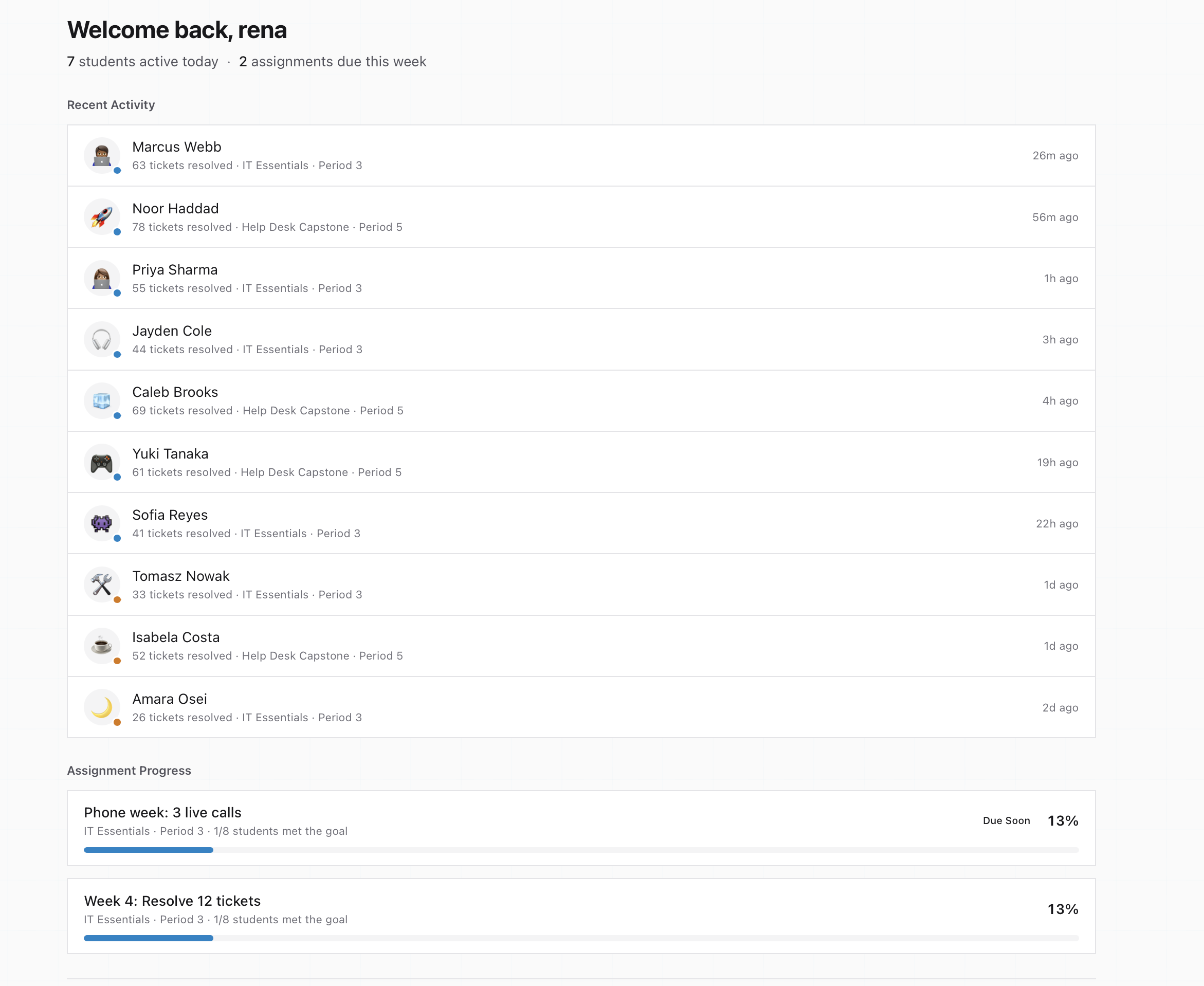
This is the part where I tell you we build a product for this, which you already guessed from the domain name. The classroom simulator gives every student a seat at a working helpdesk: a live queue, users who call and chat and describe their problems the way real users do, badly, plus working tools, Active Directory, remote desktop, deployment, to resolve what comes in. The frustrated caller is software, so she shows up on demand for all twenty-five students at once and never files a complaint about being used as a teaching aid.
For the instructor it turns the missing activity into an assignable one. Resolve twelve tickets this week is now homework you can set and verify, because the dashboard shows scores, resolutions, and activity per student, live. The gap between your course and your students’ first job stops being a thing you acknowledge at graduation and becomes a thing the Tuesday lab covers.
On money, since CTE budgets are their own discipline: licenses are per student, schools pay by purchase order, we provide the W-9 and quote paperwork districts ask for, and many US programs fund classroom software through Perkins V, though your state plan and district process govern the details. Your quote comes with a 7-day classroom trial, no card, so the evaluation can happen with a real class before any of that machinery starts.
The knowledge half of your program already works. The teachers page is where the doing half starts: request access, confirm your school email, and your classroom sets itself up. Your graduates will still be the ones who can build a PC from parts. They will also be the ones who can pick up the phone.