The point of all of it. What a first-line interview actually asks, how to answer from the tickets you have worked, and what gets somebody hired with no degree.
Every module before this one teaches the job. This one is about getting hired to do it.
Part one
On the job
The first-line interview as it is actually run: the rounds, who is in the room and what each of them is deciding, the questions that come up every time, how to build an answer, and what substitutes for a degree.
The rounds, and who is in them
A first-line support hire is two or three conversations, rarely more, and it often finishes inside two weeks because the desk is short-staffed, which is why they are hiring.
The usual rounds
Phone screen
Technical round
Offer
A resume screen filters before any of this, usually an automated keyword pass. Smaller desks fold the two rounds into one call; larger ones add a panel or a practical, a shared screen with a fake ticket and somebody watching how you work it.
Who is in the room, and what they are deciding
RecruiterAre you real, can you start, does the money work. They screen on plain language, so give an answer they could repeat accurately to the hiring manager.
Service desk leadYour future manager, and the opinion that decides it. Deciding whether you can be left alone with a user on a bad day.
Senior technicianHanded your resume in the corridor ten minutes ago. Deciding whether hiring you makes their week lighter or heavier.
HR or a peerWatching how you treat people, and whether your story holds together across both interviews.
Three things nobody warns you about. The call almost always comes on a bad line, so build in a "sorry, could you say that again" and do not let it rattle you. The interviewer has often not read your resume properly, so your first answer has to introduce you as well as answer the question. And being easy to talk to is a real qualification here: the job is mostly talking to people who are already annoyed.
The questions that always come
There is a short list and it barely changes between companies. Learn what each question is for, then answer it in your own words.
What they ask
What they are deciding
"Walk me through what you do when a user says they cannot log in."
Whether you verify who you are talking to before you touch the account, and whether you have a second and third thing to check after the first one comes back clean.
"How would you explain a technical problem to somebody non-technical?"
Whether they can put you on a phone with a finance director. Pick a real fault and explain it with no acronyms at all.
"Tell me about a time you did not know the answer."
Whether you will admit it. Bring a story where you genuinely did not know, and say how you found out.
"What is DNS?"
How far you can go before you stop, and whether you stop honestly or start inventing.
"How do you prioritize when three people say theirs is urgent?"
Whether you have a rule or just a mood. They want impact against urgency, and a check on who is blocked versus who is inconvenienced.
"Why do you want to work on a service desk?"
Whether you have thought about the actual work, or are calling it a stepping stone in front of the person who does it.
The login question is the most common opener, and most candidates answer it with "I would reset their password". That is the third step. Verify who is on the phone. Ask whether it is one person or the floor, and what changed: a new laptop, time away, a name change. Check the account for a lockout, an expiry, a disabled flag. Then reset, and say how you hand the password over without emailing it in plain text.
Walk me through this ticket
"Walk me through how you would solve this ticket." This is the question a first-line interview turns on, and on a small desk it is close to the whole technical portion. They hand you a ticket or a made-up scenario and watch how you move through it. What passes is a process you can say out loud, in order, with a reason attached to each step. With no paid experience to draw on it often arrives as "what would you do if", which is the same question with the ticket invented.
The interviewer cannot see you think, so say all of it out loud. Name what you are about to check and why before you check it. "First I would confirm who I am talking to, and whether it is just them or the whole floor" carries more weight than the fix does, because it shows the fix was reasoned.
The order to say it in
Clarify
Reproduce
Check obvious + recent
Isolate one at a time
Escalate or resolve
Change one thing at a time and say that you are, because "I swapped the cable, the port and the driver together" means you still do not know which was broken. The recent change is the highest-value question at first line: a new laptop, a password that expired over leave, an update that ran overnight. Whatever you find, the last move is writing it into the ticket.
Knowing when to stop is graded as closely as the fix, so say the trigger out loud. "If I cannot see the cause in about ten minutes, or the fix needs rights I do not have, or more than one floor is down, I escalate with what I have already ruled out." Naming a trigger, whether a time box, a rights boundary or an impact line, proves you have a rule, and that a major incident reaches the people who can act on it while it still matters.
The login answer on the previous page runs in exactly this order: verify, scope, check the account, then reset. Any ticket you have closed can be told the same way, which is what part three drills.
Occasionally a manager adds one straight technical question, "what is DNS" being the usual one. Answer as far as you can defend and then stop: it turns a name into an address, and if a name will not load while the address behind it will, that points at name resolution rather than the site being down.
Talking to users who are already upset
Most of first line is the conversation. It is talking to somebody whose morning has already gone wrong, and interviewers weigh how you handle that at least as heavily as whether you know the answer. A candidate who is calm and easy to talk to and a little unsure beats a candidate who knows more and makes the user feel stupid, every time.
Staying patient when someone is short with you, explaining a fix in the words a user already has, telling a person you do not have an answer yet and sounding like you are still on it, keeping a promise to call them back: all of that is graded in the room, usually through a "how would you handle" question. When one comes, answer it as a person. Say what you would actually say to the user, in the words you would use.
Your personality is part of what they are hiring. A desk is a small team on the phone all day, and the lead is picturing you next to them on a bad afternoon. Let some of yourself into the answers.
STAR, and the two ways it goes wrong
Every "tell me about a time" question wants a story in four parts, in order. The structure is called STAR. It exists because an unstructured answer wanders, and an interviewer who has lost the thread stops listening long before you reach the part that would have impressed them.
One answer, four parts
SituationWhere and when, in two sentences. "A printer on the second floor died the morning of a client visit." That is enough setup.
TaskWhat was yours to do, in one sentence: the piece of it that landed on you.
ActionWhat you did, in order, with the reasoning. Most of the answer, and the only part being graded.
ResultHow it ended, with something countable if you have it. Fixed in twenty minutes. Nine people back at work. An article written so it did not come back.
The first failure is spending the whole answer on the situation, because the setup is the comfortable part. Then the interviewer cuts in and you never reach the result, which was the only bit they wanted. Time it once: if the scene runs past fifteen seconds, cut it.
The second failure is "we". "We isolated the switch, we got the floor back up." A hiring manager cannot grade a team. Say what you did, even when it was the small part: "I took the calls, confirmed it was the whole floor, then escalated to networks with the list of affected rooms." That is a real contribution and it is yours.
What first line is actually testing
They are deciding one thing: whether you are safe to put in front of a user. Every first-line hire starts out knowing a fraction of what the desk will throw at them, and the lead hiring you already knows it.
Knowing the answer against showing the method
Knew the answer
Did not know
Showed the method
Strong
Strong
Stated a conclusion
Passable
The one that loses it
They score the method above the fact, because the method transfers to the next fault and to the one after that. The bottom-right corner is a confident guess with nothing behind it, and it is the most common reason a first-line candidate is turned down.
Four behaviors carry that judgment, and you can put all four into answers deliberately.
You follow a process
Verify, scope, check, change. Say the order out loud, because saying it is the only evidence they have that you have one.
You say when you do not know
"I do not know, and here is how I would find out" is a complete answer. Say the second half every time.
You escalate at the right moment
A good answer names a trigger: a time box, a rights boundary, an impact threshold. Too early hands over your own work, too late sits on a major incident.
You write things down
Mention the ticket note you left behind, and the knowledge base article that came out of a fix nobody had written down. It reads as professional maturity and almost nobody says it.
Coming in without a degree
First line is one of the few technical jobs you can walk into on evidence alone, and plenty of desk leads got there that way. A degree stands in for proof that you can be taught and will finish what you start, and the substitutes carry that better: worked tickets you can talk through, a home lab you built and broke, a certification with a date on it, a few written-up fixes.
The same fact, said two ways
What sinks it
1"I do not have a degree, so I am probably not what you are looking for."
2"I have not worked a real desk yet, but I am a fast learner."
3"I am just coming out of retail, sorry."
4"I only know the basics."
What lands
1"I came in through self-study rather than a degree. Here is what I have worked."
2"Not on a paid desk yet. I have worked lockouts, printer faults and a floor-wide outage in a simulator, and I can walk you through any of them."
3"Four years in retail, which is four years of angry people at a counter. Same skill, different counter."
4"Confident on accounts, printers and basic network triage. Weaker on anything server-side, and I know it."
Same facts on both sides. The right-hand column states them flat and names its own limit before anybody has to ask.
"I have not worked a real desk" is a question with an answer, and the answer is a concrete example told in order, which is what part three of this module is for.
Certifications, and the questions you ask them
Certifications get oversold to career changers by the people selling them. What one actually buys is a first read of a resume with no work history on it, and that is worth having.
Certification
What it buys you
CompTIA A+
The standard entry ticket, and the current exams are 220-1201 and 220-1202, so check the codes on any study material before you buy it. Gets a resume with no work history past an automated filter, and covers hardware, operating systems and troubleshooting method.
CompTIA Network+
Worth it after A+ if you want the network side. Makes the DNS and IP questions comfortable. Desks ask for it at second line more often than at first.
ITIL Foundation (v5)
A vocabulary: incident against service request, priority, escalation, change control. Cheap, quick, and it makes you sound like you have worked somewhere with a process.
Microsoft fundamentals
Most desks run on this stack. MS-900, the Microsoft 365 exam that sat closest to first line, retired on 31 March 2026, and the closest current option is AB-900, Copilot and Agent Administration Fundamentals, which covers Copilot and the administration of agents. AZ-900 covers cloud concepts and SC-900 identity and security. All of them stay at concept level, and they sit a step to the side of desk work.
A certification gets your resume read, and what you can talk through is what gets you hired. With one month before you start applying, spend it closing tickets you can describe.
What to ask them
You will be asked if you have questions, and "no" reads as no interest. Ask what a normal day looks like in ticket numbers. Ask who you escalate to at ten past five. Ask what the last major incident was and what changed afterwards. Ask what happened to the last person in this seat.
Their answers are information about them. "We do not really track ticket volume" means the desk runs on vibes and you will be measured on something invented later. "You will pick it up as you go" means no documentation and no onboarding. A long pause on the last person is worth listening to carefully.
Part two
How this works here
The Mock Interview panel: who you can sit with, what it scores you on, and how to answer its questions from tickets you have already closed.
The Mock Interview panel
Mock Interview sits in the app header. It is a Pro feature: on a free account the tab opens the upgrade dialog, and the server behind it refuses a non-Pro caller outright.
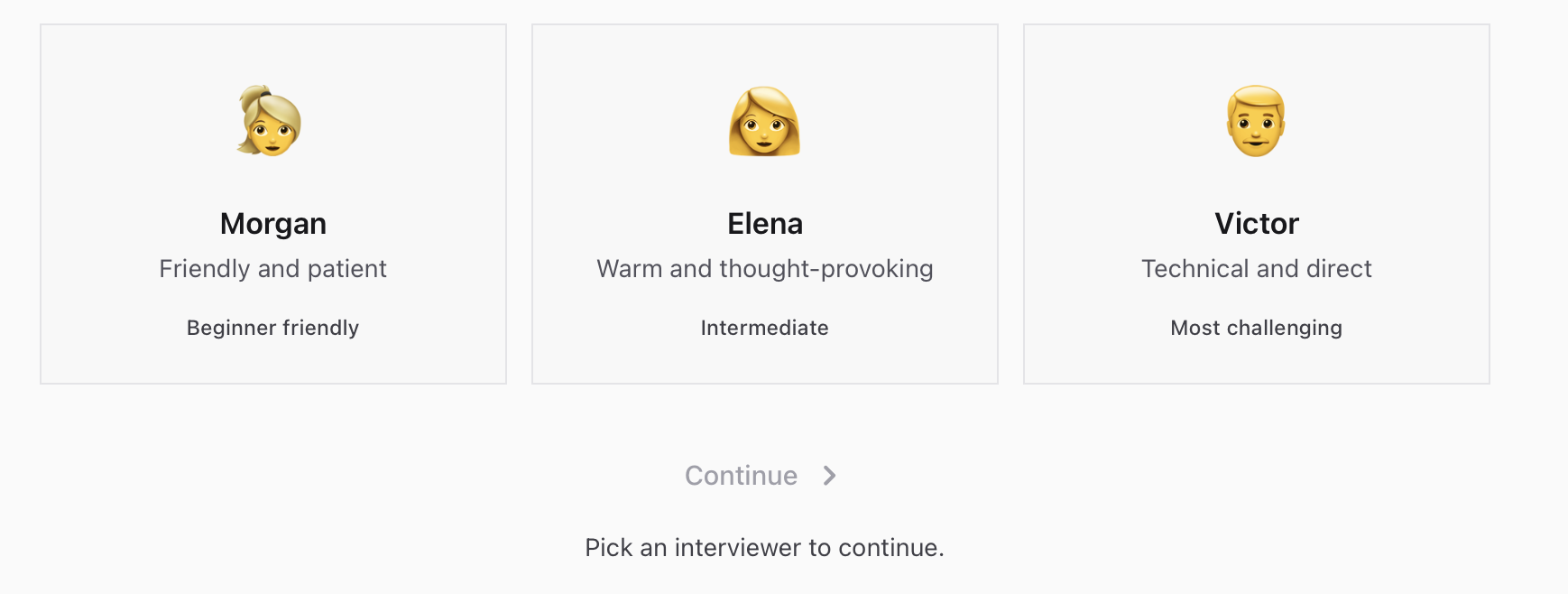
You pick one of three interviewers before anything starts and the pick is locked for the session. Morgan is steady and fair, Elena warm and curious about why you chose what you chose, Victor pushes on every vague answer and softens nothing.
Take Morgan for your first session. The cards run easiest to hardest, and a first sit is for getting through a whole conversation and reading the transcript back afterwards. Save Victor for a second run once you have answers you have already rewritten: he pushes on every vague one, which is what part three sends you back here to do.
One session, start to finish
Pick an interviewer
Check devices
Join
About five questions
Interview ends
Evaluation
The card promises fifteen to twenty minutes. In practice the interviewer starts wrapping up after about five questions, so unless your answers run long a session finishes sooner. Treat the clock as a ceiling.
The room before it starts, and the conversation itself
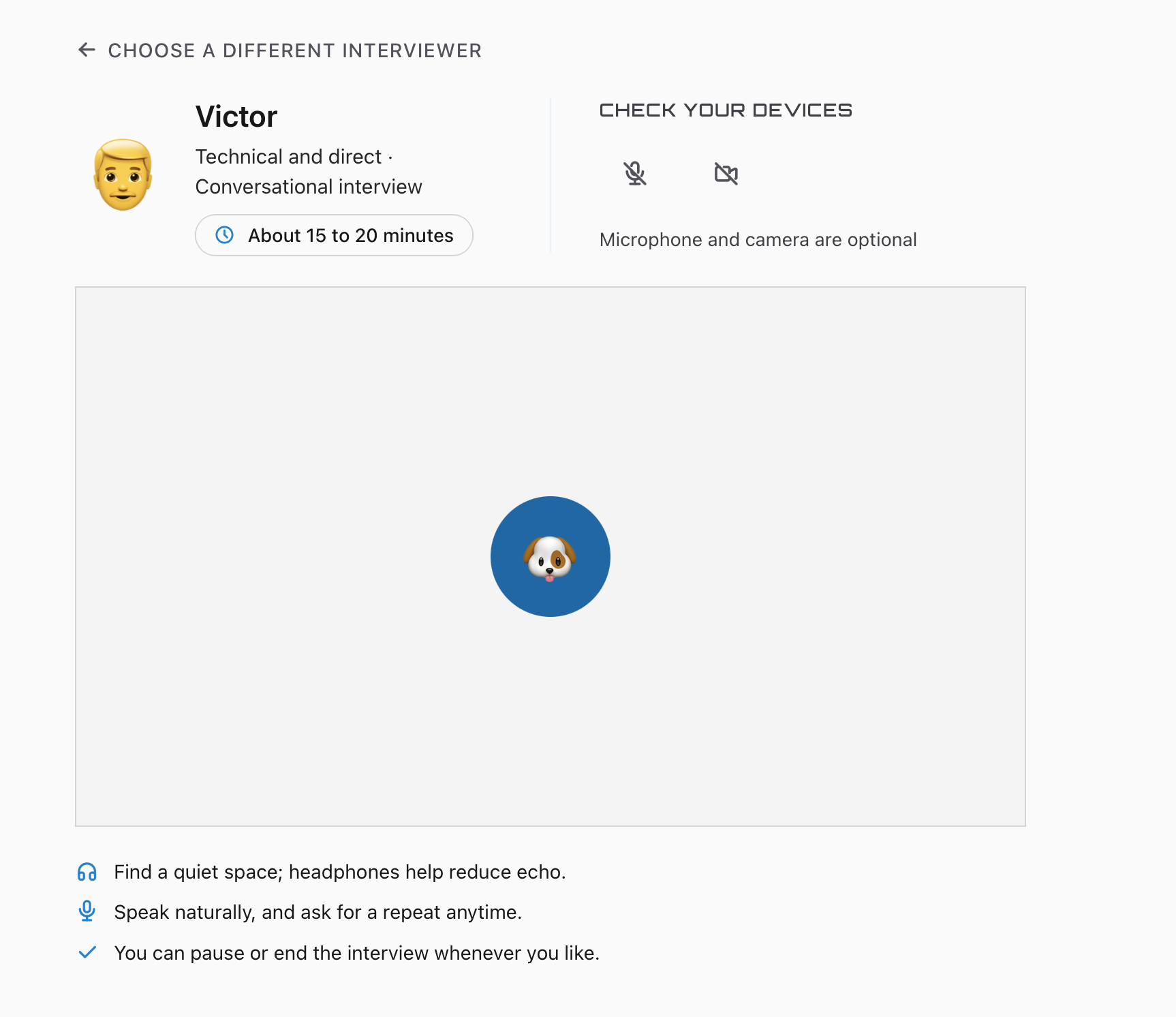
Once the pick is made you get the prejoin card: Conversational interview, About 15 to 20 minutes, and Check your devices underneath, where Microphone and camera are optional. You can speak your answers, or type them. Your choice. Typing is the Type answer box in the controls, and it unlocks only when the turn is yours.
Test the microphone on the practice run, every time, so a real interview does not open with you saying can you hear me.
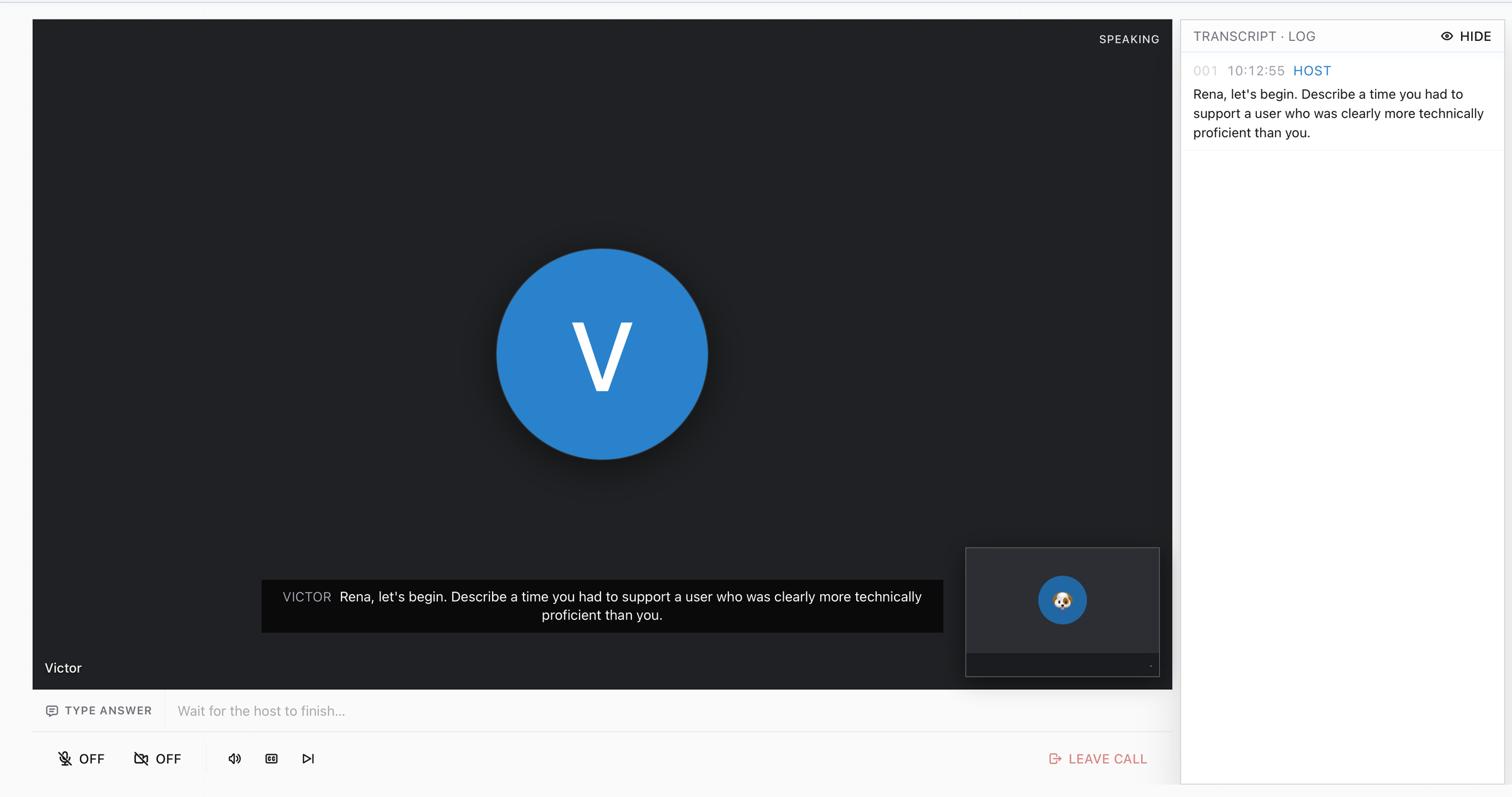
It is a conversation. One question per turn, and it reacts to the answer you gave: a vague one gets pushed on, a detailed one moves on. With no paid experience to ask about it pivots to "what would you do if". Skip to my turn cuts the interviewer off when you already know the question, and Leave call ends the session at any point.
Every word you say goes into the transcript on the right. Read it back once the session is over, because that is where a weak answer is easiest to see.
What it scores, and what it stands in for
The Interview ended screen gives you the duration, the turn counts, a transcript.txt button that saves the conversation as a timestamped file, and a scored report: an overall band, four sub-scores for communication, technical, process and rapport, then a manager note, what worked and what to improve. Two real answers is the floor for a graded one. Start new interview puts you back at the interviewer choice.
What this panel does
What it stands in for
You choose your interviewer and their difficulty
Whoever was free that afternoon, at whatever difficulty they happen to come with.
The prejoin card and its device checks
The calendar invite, and the five minutes before it where you test your microphone.
One question per turn, spoken aloud
A hiring manager working down a list on a video call or a bad phone line.
About five questions, then a close
Thirty to forty-five minutes and a dozen questions, with follow-ups inside them.
The transcript, saved and downloadable
What you can still remember of the conversation a day later. A transcript replaces that with the words you actually used.
The scored report
A scorecard the interviewer fills in after you leave and you never see.
Two rooms, two things to practice
What this room is for
1Unlimited attempts at the same question.
2A transcript you can read back cold.
3A written note on what to fix.
4A bad run that costs you nothing.
What the real room brings
1A human reading your face while you answer, and deciding from a hesitation.
2A follow-up that chases a weak answer down three levels until it finds the bottom.
3A decision at the end, and being told no is part of the job you are applying for.
Work the weak answers out here, where finding one costs you a rerun. In the real room a follow-up finds them for you.
Part three
Practice
Sit one interview end to end, then turn three closed tickets into three answers you can say out loud without reading them.